What is a Liger

Liger Photo

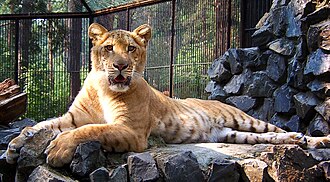
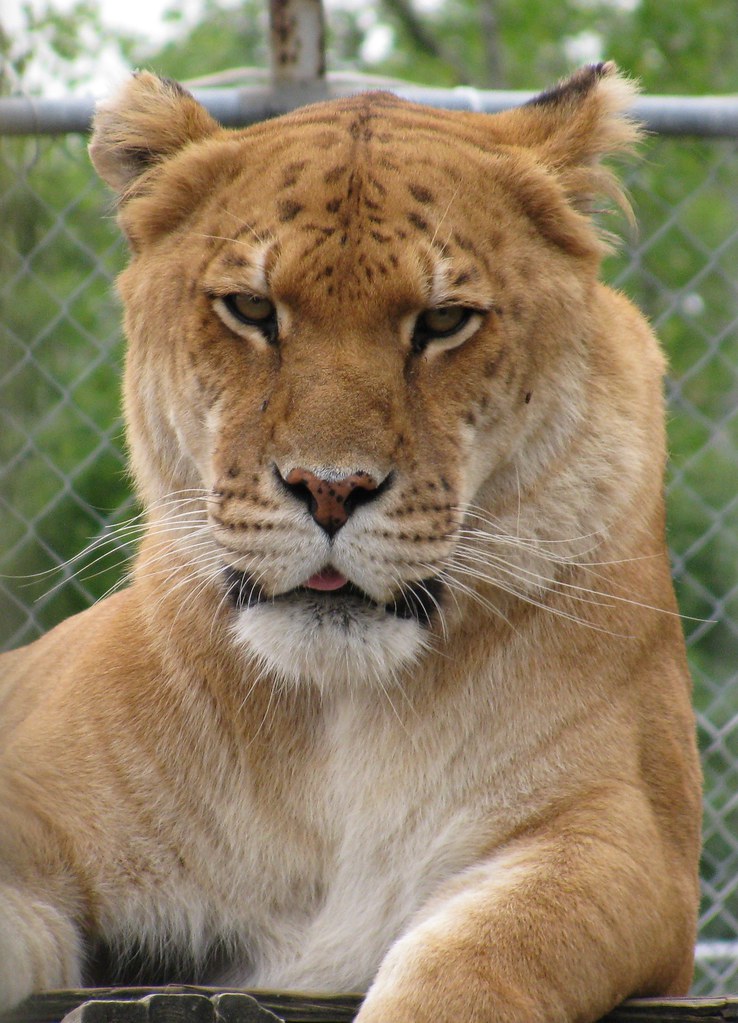
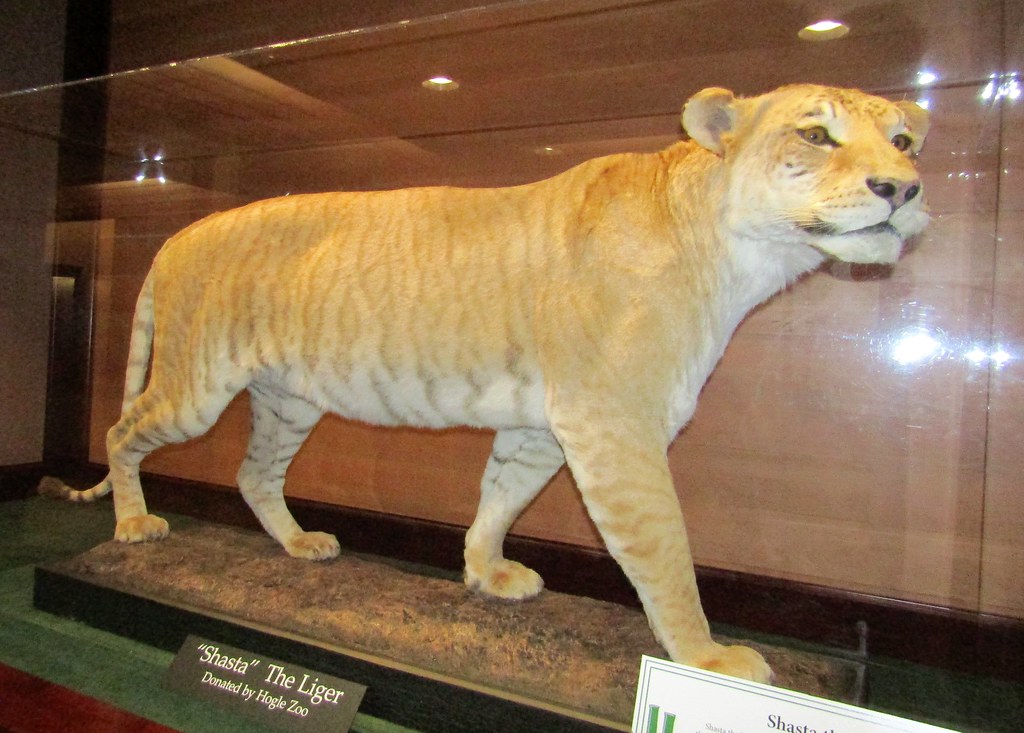
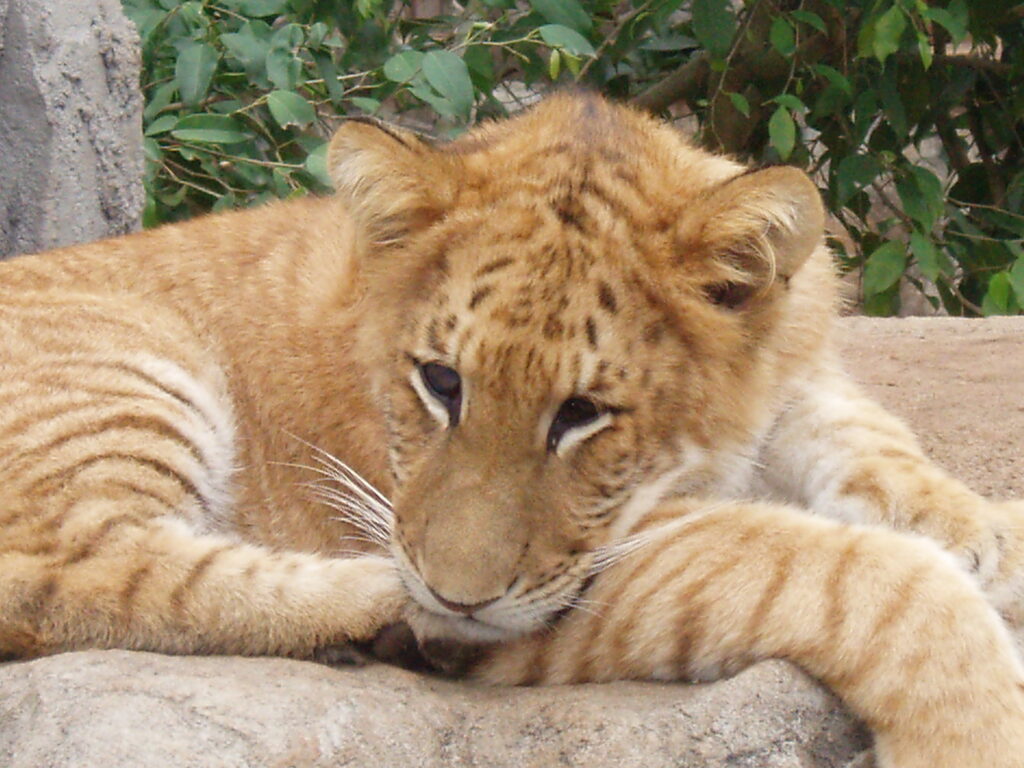
The liger is a cat born from the breeding of a male lion and a female tiger. This combination produces an offspring with more lionistic features than if the reverse pairing had occured. That would produce a more tigeristic creature known as a tigon. Both are members of genus Panthera.There is no scientific name assigned to this animal because of it’s human assisted ancestory.

A liger looks like a giant lion with muted stripes but like thier tiger ancestors, ligers like swimming. This goes against the nature of a lion but is what makes creature special. It gets the best of both parents. That is not always the case though with crossbreeds. Sometimes the results go the other way and the animal gets the worst of both parents. That would suck!

Who Breed The First Ligers?

The history of these hybrids has been very carefully worked out by Professor Valentine Bail, Director of the Science and Art Museum, Dublin, from whose papers the following account is taken. The parents of these hybrids were in a travelling menagerie owned at first by Mr. Thomas Atkins, and subsequently by his son Mr. John Atkins; and a total of six litters of hybrids were produced between the years 1824 and 1833. The parent Lion was bred in the menagerie from a Barbary Lion and a Senegal Lioness; while the Tigress was born in the collection of the Marquis of Hastings at Calcutta, and was purchased when about eighteen months old from a ship’s captain, to whom she had been given by her original owner. Being of the same age as the Lion, she was placed with him in the same cage ; and in the course of two years proved to be in cub. The following is a record of the six litters produced by the union of this pair.

First Litter: Born October the 24th, 1824, at Windsor, and comprising two males and a female. They were nourished by a female terrier, but all perished within a year of their birth. These cubs were exhibited to King George the Fourth, at the Royal Cottage, Windsor, on the final of November, by whom they were christened Lion-Tigers.

Second Litter: Born April 22nd, 1825, at Clapham Common; there were three cubs, sexes not recorded. Reared by the mother, as also were all the subsequent litters. They only lived a short time.

Third Litter: Born December 31st, 1826 or 1827, at Edinburgh; one male and two females . Mr. Ball states that the year is given as 1827 in the handbill of the menagerie from which he quotes, and the other references seem to support that date; but Mr. John Atkins says it is given as 1826 in a printed catalogue in his possession. These only lived a few months. The skin of one of them, forming the subject of Plate III,, is preserved in the Science and Art Museum at Edinburgh, and a second is in the British Museum. Sir William Jardine remarks that “the colour was brighter than that of the Lion, and the bands were better marked than they generally are in the young of tire true breed.” Indeed, from his figure, the animal has more the appearance of a Tiger than of a Lion. Writing of the cubs of the first litter in the “Library of Entertaining Knowledge,” where one of them was figured, Griffith observes that “our mules, in common with ordinary Lions, were born without any traces of a mane, or of a tuft at the end of the tail. Their fur in general was rather woolly; the external ear was pendant towards the extremity; the nails were constantly out, and not cased in the sheath, and in these particulars they agreed with the common cubs of Lions. Their colour was dirty yellow or blanket-colour; but from the nose over the head, along the back and upper side of the tail, the colour was much darker, and on these parts the transverse stripes were stronger, and the forehead was covered with obscure spots, slighter indications of which also appeared on other parts of the body. The shape of the head, as appears by the figures, is assimilated to that of the father (the Lion) ; the superficies of the body on the other hand is like that of the Tigress.”

Fourth Litter: Born October 2nd, 1828, at Windsor; one male and two females.

Fifth Litter: Born May, 1831, at Kensington, three cubs, sexes not recorded. They were shown to the Queen, then Princess Victoria, and to the Duchess of Kent. The whole group performed in a specially constructed cage at Astley’s Amphitheatre, and in 1832 were taken by Mr. Atkins for a tour in Ireland

Sixth Litter: Born July 19th, 1833, at the Zoological Gardens, Liverpool; one male and two females. One, the male, lived for ten years in the Gardens. The young male Lion-Tigers when about three years old had a short mane, something like that of an Asiatic Lion; and the stripes became very indistinct at that age.

Textual content is licensed under the GFDL from messybeast.com

Why Are Ligers Bigger Than Tigons

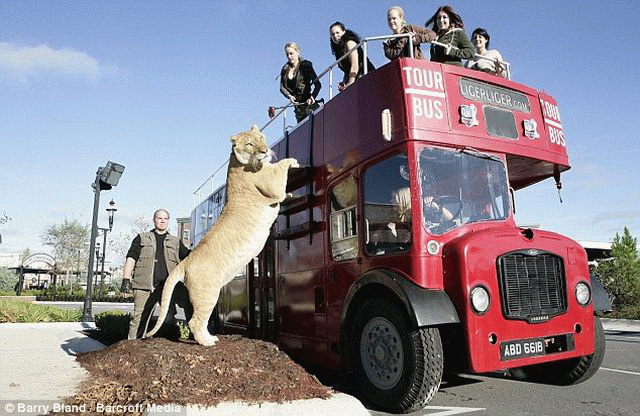
The large size of the liger and small size of the tigon is due to “genomic imprinting” - the unequal expression of genes depending on parent of origin i.e. whether certain growth genes are inherited from the male or the female. This is linked to the species’ lifestyle and breeding strategy - whether the female mates with only one male while in heat (non-competitive) or whether she mates with many males (competitive). This results in “growth dysplasia”. The following explanation is greatly simplified as a number of other genes are contributed unequally by the male and female parents and also affect the general health and longevity of the offspring. Lions live in prides led by several adult males. The lionesses mate with each of those males. Each male wants his offspring to be the ones to survive, but the female’s genes want multiple offspring to survive. The father’s genes promote size of the offspring to ensure that his offspring out-compete any other offspring in the womb at the same time. Genes from the female inhibit growth to ensure that as many offspring as possible survive and that they all have an equal chance. By contrast, tigers are largely solitary and a female on heat normally only mates with one male. There is no competition for space in the womb so the male tiger’s genes do not need to promote larger offspring. There is therefore no need for the female to compensate, so the offspring’s growth goes uninhibited.

When a male tiger mates with a lioness, his genes are not promoting large growth of the offspring because he is adapted to a non-competitive breeding strategy. However, the lioness is adapted to a competitive strategy and her genes inhibit the growth of the offspring. This uneven match means that the offspring (tigons) are often smaller and less robust than either parent.

When a male lion mates with a tigress, his genes promote large offspring because lions are adapted to a competitive breeding strategy. The tigress does not inhibit the growth because she is adapted to a non-competitive strategy. Therefore the offspring (liger) grows larger and stronger than either parent because the effects do not cancel each other out. Ligers take several years to reach full adult size, but it is a myth that ligers never stop growing.

Growth dysplasia has other effects: the size of the placenta may be affected (causing miscarriage), the embryo may be aborted at an early stage due to abnormal growth, the cub may be stillborn or may only survive a few days. In some rodents, mating Species A males with Species B females produces offspring half normal size, but mating Species B males with Species A females cause the offspring to be aborted as they try to grow to several times the normal size.

Because of the impossibility of a gene being inherited from only females, there is a competing hypothesis. This hypothesis (allthough not tested) is that the Lion’s sperm is damaged somehow during fertilization and that a growth inhibiting gene is typically destroyed. It is impossible for a gene carried on a chromosomes to be passed along only from the mother. The reason for this is there are no chromosomes that only a female can have. Female Tigons and Female Ligers both possess a tiger X chromosme and a lion X chromosome, yet only the female Ligers will grow large, this means something must happen to either alter the genes or that the cause of the growth dysplasia lies at least partially outside of the genes.

Another possible hypothesis is that the growth dysplasia results from the interaction between lion genes and tiger womb enviroment. The tiger produces a hormone that sets the fetal Liger on a pattern of growth that does not end throughout his life. The hormonal hypothesis is that the cause of the male Liger’s growth is his sterility - essentially, the male liger remains in the pre-pubertal growth phase. This is not upheld by behavioural evidence - despite being sterile, many male ligers become sexually mature and mate with females. In addition, female ligers also attain great size but are fertile.

Textual content is licensed under the GFDL

Liger Videos

Liger Science

REFERENCES AND FURTHER READING

Historical accounts of ligers and tigons (chronological order):

CJ Cornish et al (undated), R De Davison (1863), K Ackermann (1898), A Rörig (1903), Deutshe Landwirtshaftliche Presse (1904), Boettger (1906), T Noack (1908), A Sokolowsky (1909), H Przibram (1910), SS Flower (1929), L Reisinger (1929), Sir PC Mitchell (1930), H Heck (1932), RI Pocock (1935), CWG Eifrig (1937), WA Craft (1938), L Heck (1941), VG Stefko and VP Narskii (1946), American Fur Breeder (1948), Illustrated (1948), H Pilcher (1948), B Grzimek (1949), A Urbain and J Rinjard (1950), Leyhausen (1950), C Hagenbeck (1951), O Antonius (1951), H Petzsch (1951, 1956), M Burton (1952), A Kemner (1953), Farmer’s Weekly Bloemfontein (1953), F Petter (1955), H Hemmer (1966, 1968), International Zoo Yearbook (1970, 1971)

Ancestry Chart

Here’s a chart showing the results of breeding different cats and what is produced:

Father

Mother

Results

Lion

Tiger

Liger

Tiger

Lion

Tigon

Lion

Liger

Li-liger

Lion

Tigon

Li-tigon

Tiger

Liger

Ti-liger

Tiger

Tigon

Ti-tigon

Alismith44 - Liger Picture 2

ligers and tigons

another liger photo from alismith44 @ flickr

Liger and Big Cat Forums

I decided to add a liger discussion area to the site and hope that everyone will say a few words about their favorite animal - THE LIGER.

You can also make comments to all the posts on the site. It’s nice to hear what other people thing about the topics and photos that go with them. 

LINK - http://www.liger.org/forums/


Liger Cubs

Here are some awesome liger pictures from a news article out of China. Take a look at those cute baby ligers! The shot below is my favorite - looks like one big happy family. 

liger family

Peoples Daily Online

Quadruplet liger cubs play with their lion father and tiger mother at Hainan Tropical Wildlife Park and Botanical Garden in suburb of Haikou city, capital of  China’s southmost province of Hainan, May 30, 2006. The four cubs were born on March 23,2006.

liger cubs

The four-year-old male lion and six-year-old tigress look after their liger quadruplet cubs at Hainan Tropical Wildlife Park in China’s southernmost island province of Hainan May 30, 2006. The couple gave birth naturally to four ligers, two males and two females, on March 23, 2006, and now they have a total of six children survived, a twins and quadruplets since they lived together in captivity in 2004. Liger is a rare lion-tiger mix which normally has a short life expectancy.

liger picture

The tiger mother plays with its liger quadruplet cubs at Hainan Tropical Wildlife Park in China’s southernmost island province of Hainan May 30, 2006. 

Liger Dies

I found this little story and thought I’d post it for everyone to check out:

SPEARFISH - Spearfish’s biggest cat, a rare cross between a lion and tiger, has died at the Spirit of the Hills Wildlife Sanctuary.
Dr. David Elsom, a Spearfish veterinarian who donates time at the sanctuary, said the cat suffered from chronic renal failure and could not be saved despite correct diagnosis and care.
Breeding between lions and tigers happens only in captivity, producing offspring called ligers. There is only a handful in the world, Elsom noted. “I had never even seen a liger until I started caring for this one,”

Read The Rest at:

http://www.zwire.com/site/news.cfm?BRD=1300&dept_id=156923&newsid=16824277&PAG=461&rfi=9


Close
E-mail It